
Honoring Ada Veterans
Inspired by the nation’s 250th anniversary in 2026, we are pleased to participate in two initiatives honoring those who have served from Ada.
Ada Veterans Memorial
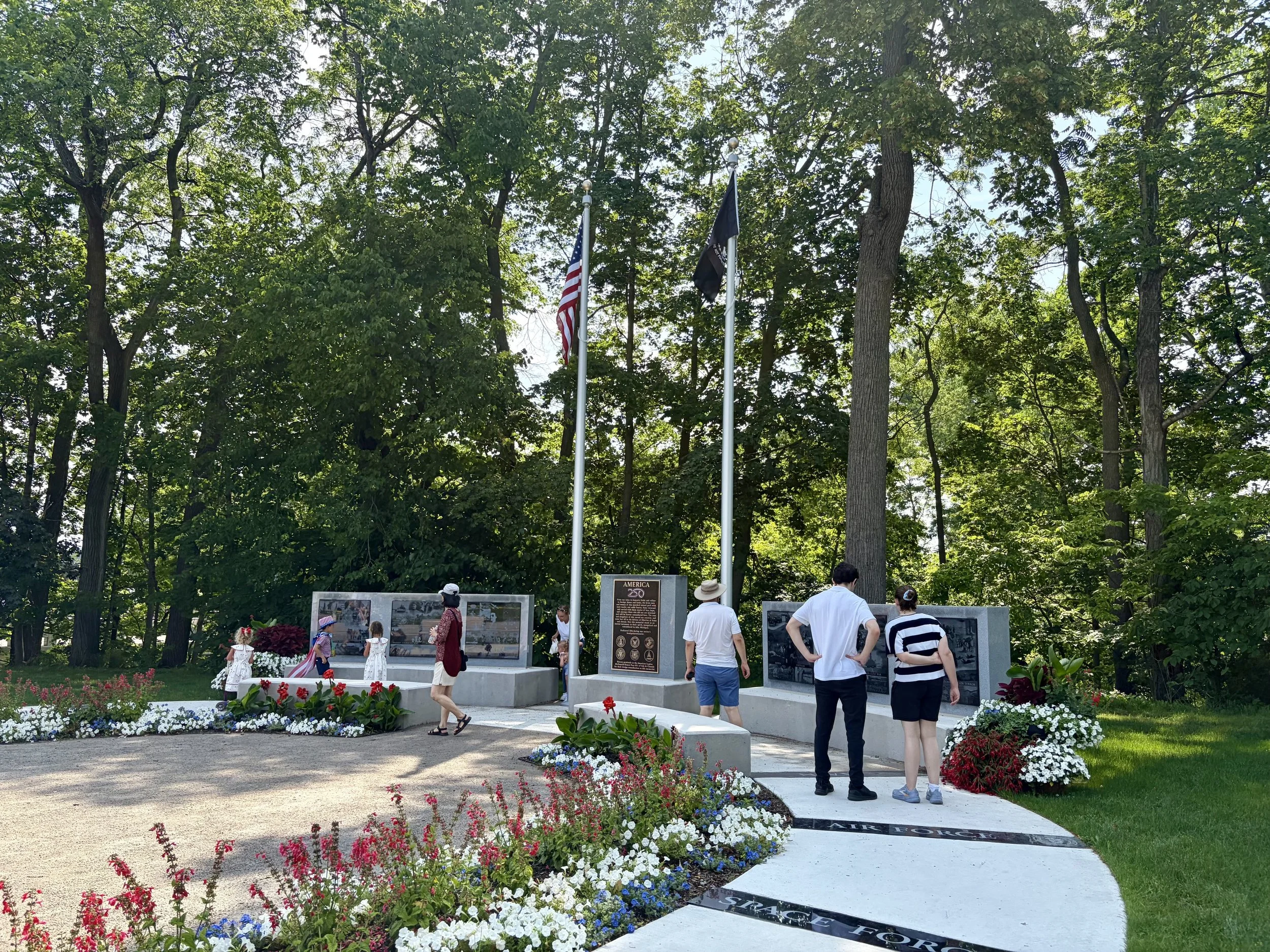
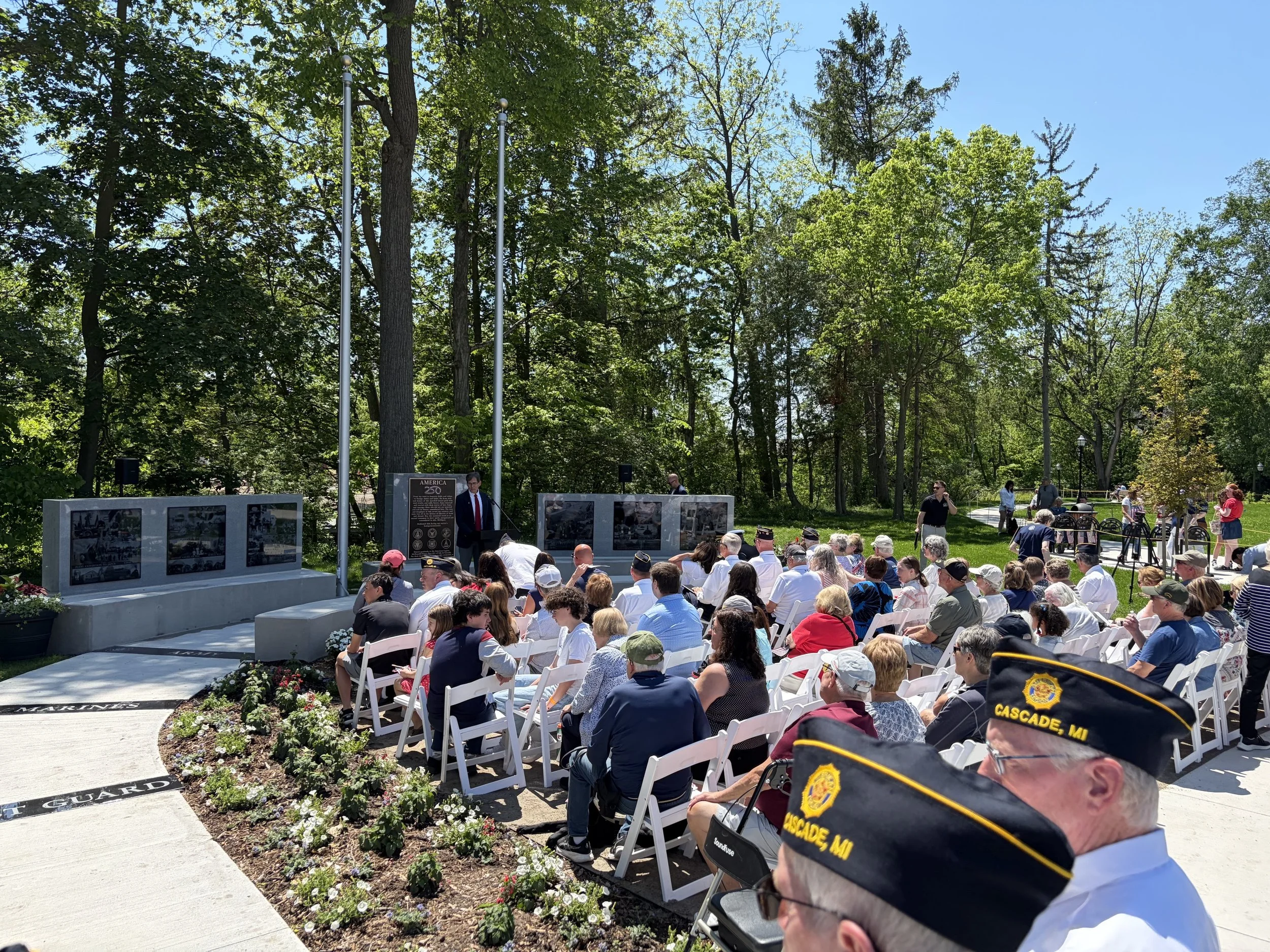
On May 25, 2026, Ada Township dedicated a meaningful monument to service in the Armed Forces. It is located at the corner of Thornapple River Dr. and River St., adjacent to the driving bridge over the Thornapple River.
See detailed information below.
Veterans’ Exhibit Interactive
The first phase of a new interactive has launched at the Ada History Center. A touchscreen in the permanent exhibit, Ada Is…Answering the Call, enables visitors to search for Ada Veterans by last name and by service era. We’ve begun with more than 100 individuals who served from the War of 1812, War with Mexico, Civil War, and Spanish-American War. Successive eras are currently being researched to be added to the interactive.
From Ada Township
⭐
From Ada Township ⭐
The Ada Veterans Memorial, completed in May 2026, was conceived as a significant feature of Ada Township’s Connecting Community Campaign, a community investment initiative that brought together private philanthropy and public stewardship to support transformative public amenities, including the Ada Pedestrian Bridge and the creation of Covered Bridge Park.
As part of the campaign’s vision, the Township sought to establish a lasting memorial that would honor all Americans who have served their country but also provide a local connection for Ada residents who have been impacted by military service. From the outset, Township staff sought to create a monument that would be distinctive to Ada, rather than replicating the form or character of veteran’s memorials found elsewhere. Staff recognized that achieving this objective required the direct perspective of those who had served. The Township therefore engaged the McDonald-Osmer American Legion Post 451, whose members expressed strong support for participating in the effort. Throughout 2025, Township staff, representatives of the Ada Historical Society, and members of McDonald-Osmer American Legion Post 451 met on several occasions to develop the monument’s vision, guide composition, and establish symbolism. These discussions informed an approach intended to connect the history and identity of Ada with the broader experiences of those who served, including the experience of leaving their community to serve in conflicts abroad and ultimately returning home.
The resulting monument represents a collaborative effort to commemorate military service by all Americans and to draw closer the human experiences both at home and abroad. It provides a permanent place for reflection, remembrance, and recognition of the sacrifices made by those who have served in United States Military.
⭐
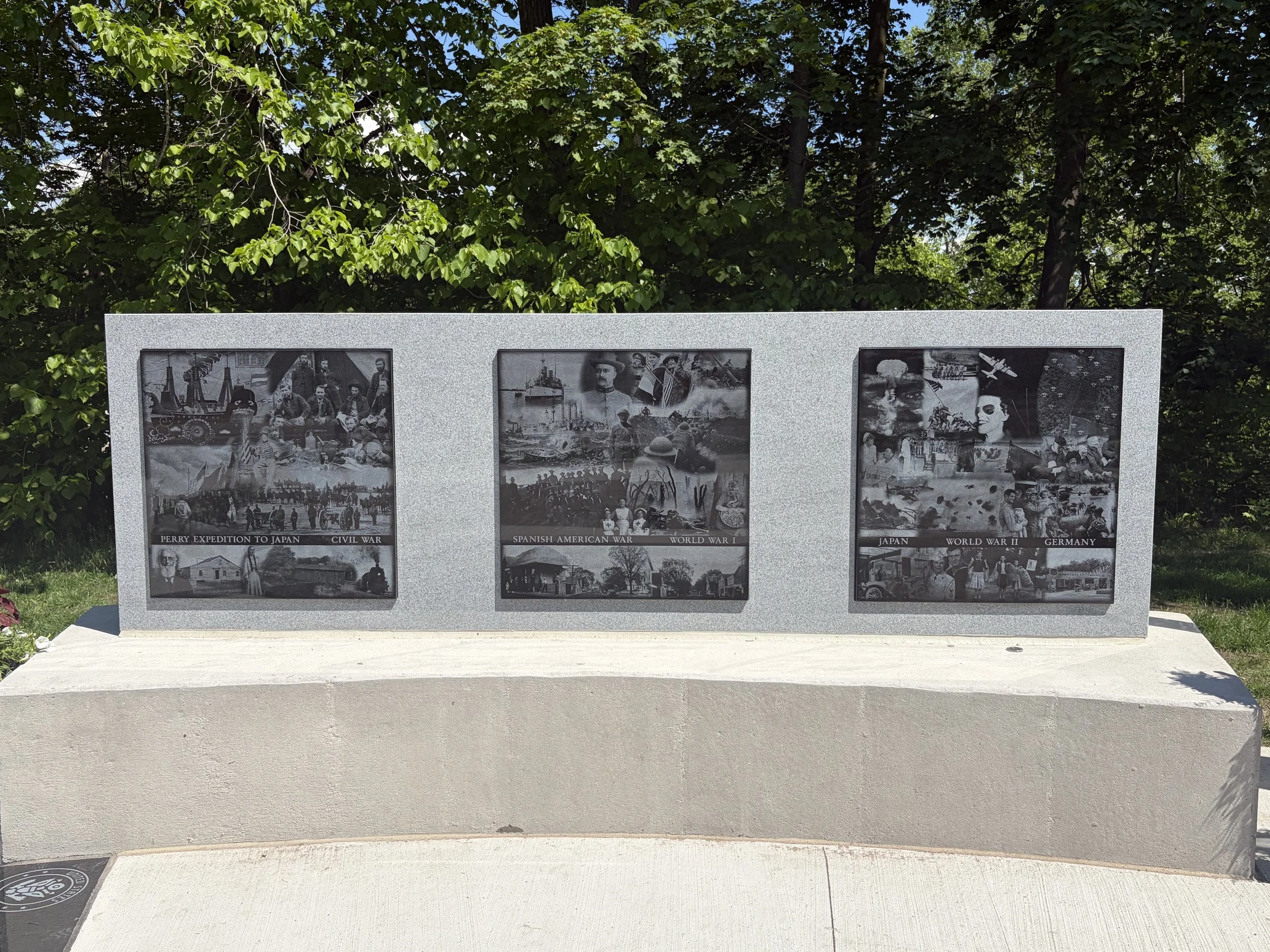
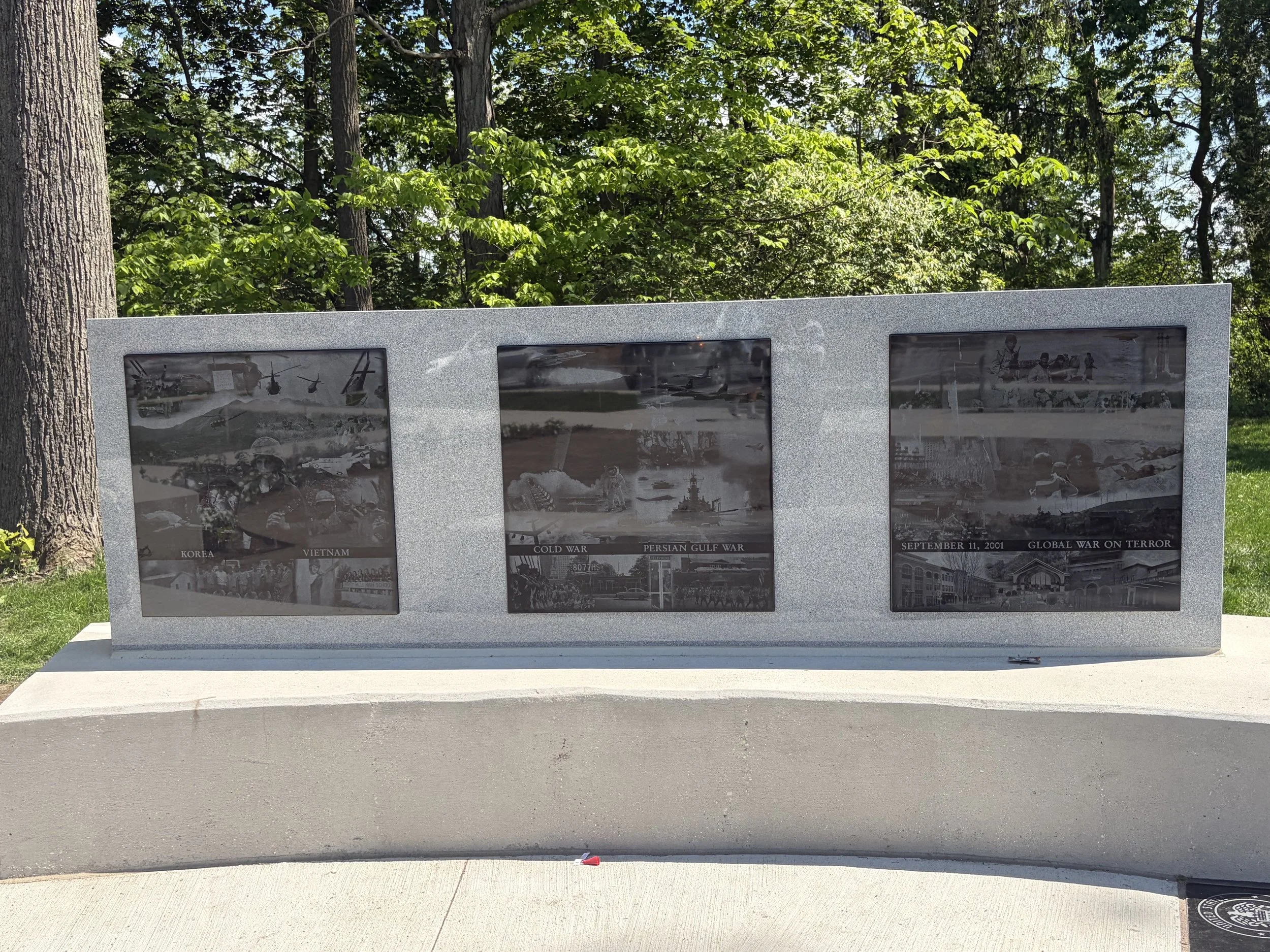
On the Ada Veterans Memorial, each of the six black granite plaques commemorates military service from different eras of our community’s past.
Each plaque’s upper block of images represent the broad experience of American service through the eras.
The bottom of each panel features images specifically from Ada, grounding each era in the experience on the home front - from those who were doing their part at home to the “home” for which veterans were fighting.
⭐
By Thomas “Brett” Talbot, American Legion Post 451
Why is the Perry Expedition included in this memorial?
The Perry expedition forced the Tokugawa Shogunate to open trade, forever changing the direction and destiny of Japanese Empire. This image was selected as it represents an early example of American military diplomacy abroad. The United States eventually became the world’s greatest power in-part because it became a great naval power and employed economic & cultural influence, military power and trade to follow her interests in spaces abroad.
Why is the US Civil War included in this memorial?
The American Civil War (1861–1865) began after eleven Southern states seceded following Abraham Lincoln’s election, seeking to preserve slavery and form the Confederacy against the Union. Four years of industrial-scale combat, including major battles such as Gettysburg and the fall of Atlanta, produced more American deaths than any other U.S. war. Union victory preserved the nation, abolished slavery through the 13th Amendment, and left the South economically devastated and under Reconstruction.
Michigan contributed 90,000 men (23% of the male population) including 1,600 black soldiers. Michigan troops fought in more than 800 engagements with about 14,850 fallen, ranking Michigan’s death total sixth among Union states. When the 1st Michigan Infantry reached Washington on May 16, 1861, President Lincoln declared “Thank God for Michigan”. Governor Blair sent an initial seven regiments though Lincoln had requested one. Michigan’s Keweenaw copper mines provided 90% of Union copper for use in percussion caps, bronze artillery, naval fittings and telegraph wire. Due to its proximity to Canada, Michigan also maintained a home-guard against possible Confederate raids from Canada.
Why is the Spanish American War included in this memorial?
The Spanish-American War of 1898 was a brief conflict in which the United States defeated Spain after intervening in Cuba’s war for independence, following the explosion of the USS Maine in Havana harbor and intense public pressure. American forces quickly won at sea and on land in Cuba and the Philippines. In the Treaty of Paris, Spain ceded Puerto Rico, Guam, and the Philippines to the United States and relinquished control of Cuba. The war marked the emergence of the United States as an overseas imperial power.
Why is World War I included in this memorial?
World War I marked the United States’ first large-scale intervention in a European conflict and its emergence as a major world power after late entry in 1917 helped tip the balance toward Allied victory. President Woodrow Wilson framed the war as a crusade to “make the world safe for democracy,” advancing the Fourteen Points and the League of Nations, though the Senate’s rejection of the Treaty of Versailles limited immediate U.S. diplomatic influence. Domestically the war accelerated industrial mobilization, expanded the federal government, and brought social changes including greater roles for women and new restrictions on civil liberties, while the 1918 influenza pandemic compounded the human cost. The conflict left a mixed legacy of heightened international engagement, economic strength, and unresolved isolationist sentiment that shaped American policy into the interwar years.
Why is WWII included in this memorial?
From the American perspective, World War II began with Japan’s surprise attack on Pearl Harbor on 7 December 1941, which pulled a previously divided United States into a two-ocean war against the Axis. The U.S. adopted a “Germany first” strategy while simultaneously fighting a vast Pacific campaign of carrier battles, island-hopping, and submarine warfare, turning the tide at Midway in 1942 and later at Guadalcanal, Saipan, and Iwo Jima. On the home front the country became the “arsenal of democracy,” mass-producing ships, aircraft, and tanks while millions of women entered factories and military support roles (WAC, WAVES, WASP) so men could fight overseas.
In Europe, American forces helped defeat Germany through the 1944 D-Day invasion, the Battle of the Bulge, and the drive into the Reich; in the Pacific they closed on Japan after Okinawa. The war ended in 1945 with Germany’s surrender in May and Japan’s after the atomic bombings of Hiroshima and Nagasaki and the Soviet entry into the Pacific war, leaving the United States as the dominant Allied power and marking the start of its global leadership role.
More than 16 million Americans served in uniform in World War II—about one in nine people then living in the United States—and roughly 405,000 died, including about 292,000 battle deaths; another 671,000 were wounded. Sacrifice was not only combat deaths: tens of thousands more died of wounds, accidents, and disease; more than 120,000 were captured; and on the home front families lived with rationing, Gold Star flags, and factories converted to tanks, bombers, and ships. About 350,000 women served in the WAC, WAVES, WASP, and related roles so men could go overseas.
In Michigan, about 613,543 Michiganders served. State tallies commonly used in Michigan commemorations put wartime deaths at 10,263 and wounded at 29,321. Official Army/AAF statistics by state of residence list 13,057 Michigan Army deaths (including battle and nonbattle) and 38,739 Army battle casualties of all kinds. Navy, Marine Corps, and Coast Guard lists for Michigan record 2,498 combat dead, 32 dead in prison camps, 43 missing, and 3,609 wounded. Michigan’s industrial contribution—Willow Run B-24s, Detroit tanks and engines—was part of the same national effort that sent so many of its people abroad.
Kent County historians record that more than 30,000 men from Kent County entered the armed forces. Two Kent County soldiers were among the Americans killed on D-Day. Complete official county death totals that combine Army, Navy, Marines, and Coast Guard in one published figure are harder to pin down than state numbers; Grand Rapids compiled wartime lists of the dead and missing specifically to honor them on a downtown memorial. Cascade and Ada. Cascade Township’s 1946–47 war memorial named three World War II dead: 1st Lt. Edward W. McDonald (wounded over Japan, died on Saipan), Cpl. James C. Jasperse (died in Newfoundland), and Sgt. Louis G. Criner (B-17 gunner killed over Germany). Ada/Cascade later honored other local veterans as well, including 442nd RCT soldier Virgil Westdale. Those names stand for a small-township share of the same national cost: almost every community sent people; some never came home.
Why is the Korean War included in this memorial?
The Korean War began on 25 June 1950 when North Korea invaded South Korea; President Truman committed U.S. forces under a United Nations mandate to halt communist expansion and prevent a wider war. After early defeats and a desperate defense of the Pusan Perimeter, General MacArthur’s Inchon landing reversed the campaign, UN forces recaptured Seoul and drove north toward the Yalu, and then massive Chinese intervention in late 1950 forced a long, bloody retreat and a grinding stalemate near the 38th parallel. Americans fought two more years of costly hill battles and trench warfare while armistice talks dragged on; about 5.7 million served during the war years, 36,574 died in the Korean theater (33,739 of them hostile deaths), and 103,284 were wounded. The fighting ended with an armistice on 27 July 1953 that restored a divided Korea and a demilitarized zone but produced no peace treaty. The conflict became known in the United States as the “Forgotten War,” yet it was the first major armed test of Cold War containment and left a permanent U.S. military presence on the peninsula.
Michigan’s Role in the Korean War
Official National Archives extracts of the Defense Casualty Analysis System list 1,492 fatal U.S. military casualties with home of record in Michigan. Other published tallies differ (about 1,242 in some state rankings; Honor States lists about 1,526), because lists mix hostile deaths, later declared deaths, and home-of-record rules. Michigan also paid a state bonus to residents who served honorably between 1950 and 1953. A Grand Rapids Korean War memorial and honor roll stand in Veterans Memorial Park downtown. cyndislist.com
Kent County memorials list 56 among the fallen: 47 Army soldiers whose home of record is given only as “Kent,” plus Marines and airmen from Grand Rapids, Sparta, Lowell, and Byron Center. Examples include Army PFC Fred W. Benedict (7 Aug 1950), PFC Gene M. DeYoung (5 Sept 1950), Sgt. Louis V. Wilkowski (25 Nov 1950; remains not recovered), and Marines such as PFC Samuel S. Sage of Grand Rapids (7 Dec 1950) and PFC Richard F. Guiles of Sparta (30 June 1951).
Why is the Vietnam War included in this memorial?
The Vietnam War grew out of Vietnam’s struggle for independence after 1945 and became a Cold War proxy conflict: the United States backed South Vietnam against North Vietnam and the Viet Cong. After the 1964 Gulf of Tonkin Resolution, U.S. involvement escalated into a large ground, air, and riverine war. American troop strength peaked at about 543,000 in April 1969. Direct U.S. combat ended with the 1973 Paris Peace Accords; Saigon fell on 30 April 1975. About 2.6–2.7 million Americans served in South Vietnam. Official U.S. deaths total 58,220 (about 47,400 hostile). Hundreds of thousands more were wounded. Vietnamese military and civilian deaths ran into the millions; estimates commonly cited are on the order of 1.1 million North Vietnamese/Viet Cong fighters and 200,000–250,000 South Vietnamese soldiers, plus large civilian losses.
Michigan’s Role in the Vietnam Conflict
More than 400,000 Michigan residents served during the Vietnam era. Official state figures put deaths at about 2,650–2,657, with 36 prisoners of war and 48 still unaccounted for. That places Michigan among the highest-loss states in raw numbers (home-of-record lists often show roughly 2,650). Recent VA-style counts put living Vietnam-era veterans in Michigan on the order of 170,000–200,000, depending on the year and definition. The University of Michigan was an early center of antiwar protest (including 1965 sit-ins at a Selective Service office).
Vietnam Veterans are feature prominently among members of the Cascade-Ada American Legion Post 451. Kent County and Cascade/Ada. Kent County’s losses are recorded on the Kent County Vietnam War Memorial (Veterans Memorial Park, downtown Grand Rapids), dedicated in 1974; the two inscribed stones list well over a hundred names, most with home cities of Grand Rapids, Cascade, Wyoming, Sparta, Lowell, Rockford, Grandville, Caledonia, Alto, and Ada. Four men on the official Michigan casualty list have Ada as home of record:
Abe Richard De Young (Army SP4, died 2 May 1967)
James Joseph Heether II (Marine PFC, died 19 October 1966)
Melvin Ray Thomas (Army SGT, died 15 May 1970)
Randall Craig Van Haitsma (Army CPL, died 20 May 1970)
Why is the Cold War included in this memorial?
The Cold War (roughly 1947–1991) was a global ideological, political, and military rivalry between the United States and its allies and the Soviet Union and its allies, fought through alliances, proxy wars, espionage, economic competition, and an unprecedented nuclear arms race rather than direct great-power combat. It divided Europe, shaped decolonization and conflicts from Korea and Vietnam to Afghanistan, and produced institutions such as NATO, the Warsaw Pact, and the United Nations’ postwar security architecture. The confrontation mattered because it organized world politics for nearly half a century, drove massive advances in missiles, computing, spaceflight, and intelligence, and repeatedly brought humanity close to nuclear catastrophe—most famously during the Cuban Missile Crisis. Its end with the Soviet collapse left the United States as the dominant power and reset the international system that still frames today’s security debates.
This memorial plaque concentrates on nuclear weapons systems to represent the high stakes and anxiety provoking nature of this prolonged inter-civilizational conflict. The Space Race is also represented in two images: The Soviet Sputnik which opened the race and the Apollo 11 moon landing which ended it.
Why is the Persian Gulf War included in this memorial?
The Persian Gulf War began when Iraq invaded and occupied Kuwait in August 1990, prompting the United States to lead a broad international coalition that first defended Saudi Arabia (Desert Shield) and then, after a UN deadline passed, launched Operation Desert Storm in January 1991. A six-week air campaign smashed Iraqi air defenses, command systems, and fielded forces, after which a 100-hour ground offensive liberated Kuwait and drove Saddam Hussein’s army back across the border. The coalition won a lopsided military victory with very low American combat deaths, but left Saddam in power and Iraq under sanctions and no-fly zones. In U.S. history the war marked the first major post–Cold War use of American power, restored confidence after Vietnam, showcased precision weapons and stealth, and established a pattern of coalition warfare and long-term Middle East military presence that shaped the next three decades.
Why is the Global War on Terror (GWOT) in this Memorial?
9/11: On September 11, 2001, 19 al-Qaeda hijackers seized four U.S. airliners and flew two into the World Trade Center towers in New York, one into the Pentagon, and a fourth into a field in Pennsylvania after passengers fought back. The attacks killed 2,977 people, not counting the hijackers, and were the deadliest foreign assault on American soil. Al-Qaeda leader Osama bin Laden planned the operation from Taliban-controlled Afghanistan. The attacks transformed U.S. security and foreign policy, leading to the Department of Homeland Security, expanded surveillance, and a declared global war on terror.
The Global War on Terror: The United States and allies invaded Afghanistan in October 2001 to destroy al-Qaeda’s sanctuary and topple the Taliban; the Taliban were driven from power quickly, but a hostile occupation lasted two decades and ended with a precipitous unilateral U.S. withdrawal in 2021 and the Taliban’s return.
In 2003 the United States invaded Iraq, citing weapons of mass destruction and alleged links to terrorism; no stockpiles were found, and the occupation fueled insurgency and sectarian war. U.S. forces killed bin Laden in Pakistan in 2011, yet the Iraq conflict and the Syrian civil war helped produce ISIS, which seized large parts of Iraq and Syria in 2014 before a U.S.-led coalition dismantled its territorial “caliphate” in 2017.
The GWOT campaigns cost trillions of dollars, killed hundreds of thousands, and reduced the chance of another 9/11-scale attack on the United States, but they did not end jihadist violence or produce stable outcomes in Afghanistan or Iraq.
In 2026, due to concerns regarding Iranian proxy wars, terrorism, impending ballistic missile overmatch and nuclear proliferation, the United States and Israel opened a large-scale air campaign against Iran—killing Supreme Leader Ali Khamenei and hitting nuclear sites, missile forces, and military infrastructure following up with a crippling economic blockade. This represented the culmination of 47 years of hostility between the Islamic Regime and Western Civilization.
The Main Images...
⭐
The Main Images... ⭐
Perry Expedition to the Civil War – The images reflect the growing community at the mouth of the Grand and Thornapple Rivers in the mid-1800s. From left to right:
• Rix Robinson, the first non-Native settler here. He came to operate the fur trading network. When Michigan became a state, Robinson served in many roles including as a state senator, assistant circuit court judge, and first township supervisor.
• Rix Robinson’s home on Headley St. was believed to be built in the 1836 and demolished about 1915.
• Magdalene LaFramboise and her husband Joseph established the fur trading network along the Grand River that extended up to Mackinac Island. After his death, she grew the business into a very successful global venture.
• Ada’s iconic covered bridge over the Thornapple River was first built in 1867 to convey residents into the village and farmers across the river to the mills on the other side.
• The Detroit and Milwaukee Railroad, later Grand Trunk Western, first chugged into Ada in the 1850s.
Spanish American War to World War I – Ada was a busy place at the turn of the 20th century. The village businesses included general stores, a grist mill, carpenters, physicians, carriage makers, a boot and shoe maker, blacksmiths, a mason, a cooper, and sawmill. From left to right:
• Ada’s Grand Trunk Western Depot, c.1920. Passenger service carried Ada residents into the world for more than a century.
• Ada Drive looking northeast, c.1915. The building on the left housed the Citizens Bank and Masonic Lodge.
• Ada Drive looking southwest, c.1915. The block of stores on the right were the Ada Drugstore, Ada Meat Market, and a farming implements store.
World War II – Ada was a small farming community called to sacrifice during the war years. From left to right:
• The Ada Garage operated out of today’s hardware store block, serving the community’s needs at the advent of automobiles.
• Charlotte (Fitch) and Flavius Tworek both served during WWII. Like so many others from Ada, they answered the call. Charlotte grew up in the house that remains today at the corner of Thornapple River Drive and Fase Street.
• Children gathered milkweed – and were paid for it! The buoyant, water-repellent fiber was used in military life jackets.
• Ada’s service station, c.1956. There has been a gas station on the corner of Thornapple River Drive and Ada Drive since 1918.
The Ada Images...
⭐
The Ada Images... ⭐
Korea to Vietnam – The years 1950-1975 saw further growth with the rise of the suburb. From left to right:
• Weaver’s Market was a popular grocery and lunch spot adjacent to the hardware store.
• The 1957 Ada Merchants baseball team. Leonard Fase is seen kneeling third from right. The ballpark that was once at the covered bridge was named Leonard Field after Fase’s death in a car accident in 1964.
• Selections from the recently consolidated Forest Hills High School yearbooks, late 1960s-1970.
Cold War to Persian Gulf War – Ada Township grew from 1,966 residents in 1950 to 9,882 in 2000. From left to right:
• The nation celebrated the American Bicentennial in 1976.
• The Ada Post Office on Ada Drive was originally dedicated by Rep. Gerald Ford in July 1958.
• Shoppers Square with an IGA grocery store is built on a flood plain land previously used as a baseball field. The store becomes Adagate’s grocery store.
• Boy Scouts participate in a 4th of July parade.
September 11, 2001 to Global War on Terror – Beginning in 2006, Ada Township prepared for new development in the village core with the Envision Ada plan. This initiative resulted in several new additions to the community. From left to right:
• The block of retail, office space, restaurants, and the Ada Hotel along River Street.
• The Van Andel Family Amphitheater at the new Legacy Park is the site for summer concerts.
• New construction with an “Ada, Michigan” decorative stone.
• The Amy Van Andel Library – Ada Community Center opened with a Kent District Library Branch in 2021.
Historic Service.
Modern Technology.
Our neighbors down the road, Lowell Granite, brought Ada’s collaged historic images to life.
Check out the engraving on black granite of this small sample piece. Incredible!